
Nurse Call & Healthcare field answer
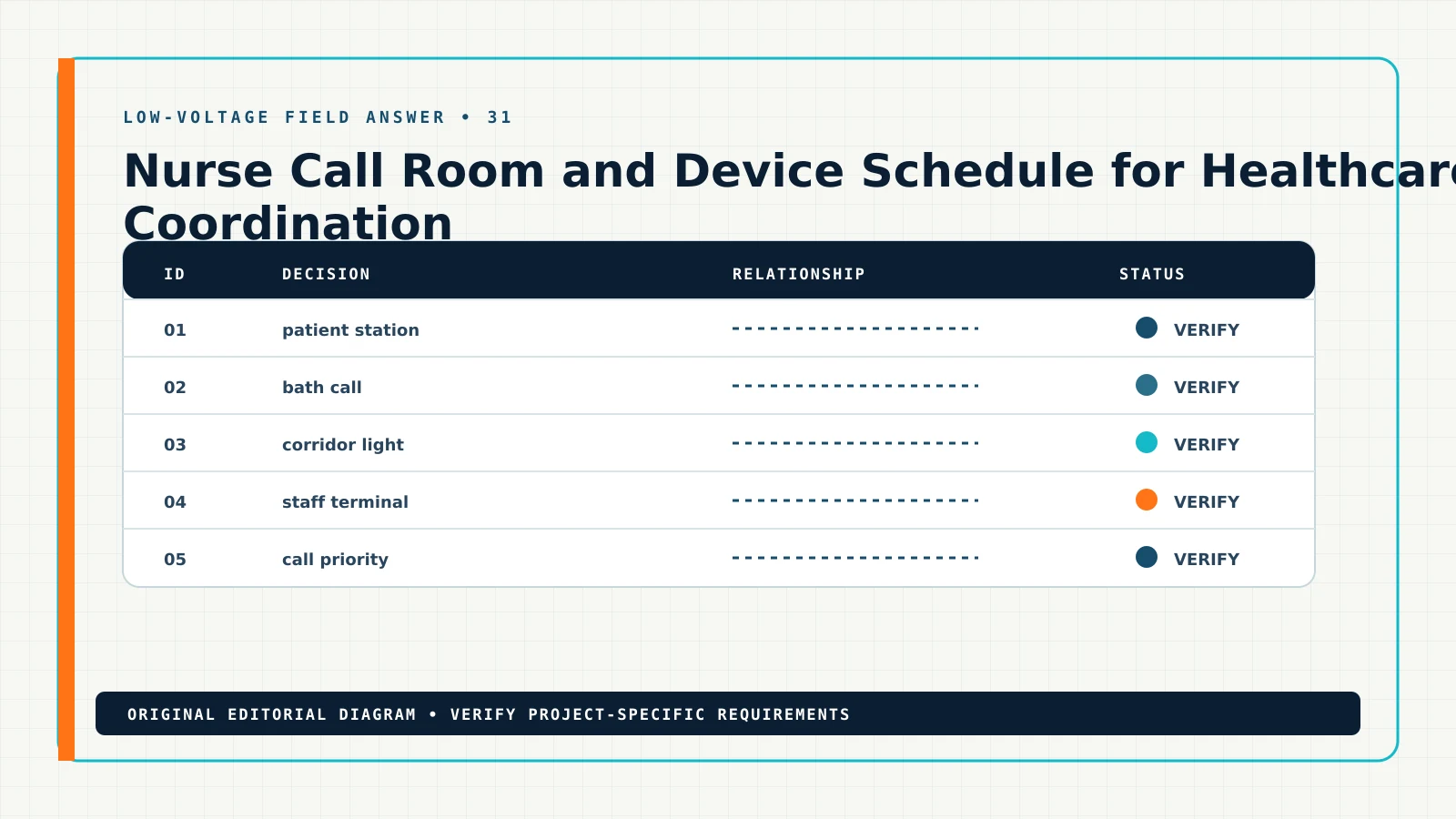
Nurse Call Room and Device Schedule for Healthcare Coordination
Coordinate each patient, toilet, corridor, staff, duty, code, pillow-speaker, annunciation, and interface endpoint with room function, call type, priority, power, network, cable, and test. This contractor-focused guide answers the search directly, shows the project records that should carry the decision, and explains how to move from preliminary intent to a traceable proposal and field handoff.
nurse call room device schedule: the practical answer
Coordinate each patient, toilet, corridor, staff, duty, code, pillow-speaker, annunciation, and interface endpoint with room function, call type, priority, power, network, cable, and test. A useful answer does not begin with a product count or a decorative symbol. It begins with the outcome the customer or operator needs, the field evidence available, the system relationships that produce the outcome, and the constraints that could change the work.
Build the record so another qualified person can audit it. Every key location, endpoint, cable, pathway, port, controller, rack, power source, network service, software dependency and test should have an identity appropriate to the project. Every important value should show whether it is verified, selected, calculated, assumed, excluded or awaiting another party. That distinction prevents early planning information from becoming an accidental promise.
For nurse call & healthcare, keep the focused question connected to the broader system. Coordinate patient, staff, code, bath, corridor, console, mobile, reporting, network, power, room, integration, testing, and turnover requirements without obscuring clinical workflow. The immediate answer may sit on one page, but it can affect schedules, diagrams, infrastructure, labor, licensing, customer responsibilities, commissioning and closeout. A professional workflow exposes those consequences before pricing is locked.
Six inputs that make the answer defensible
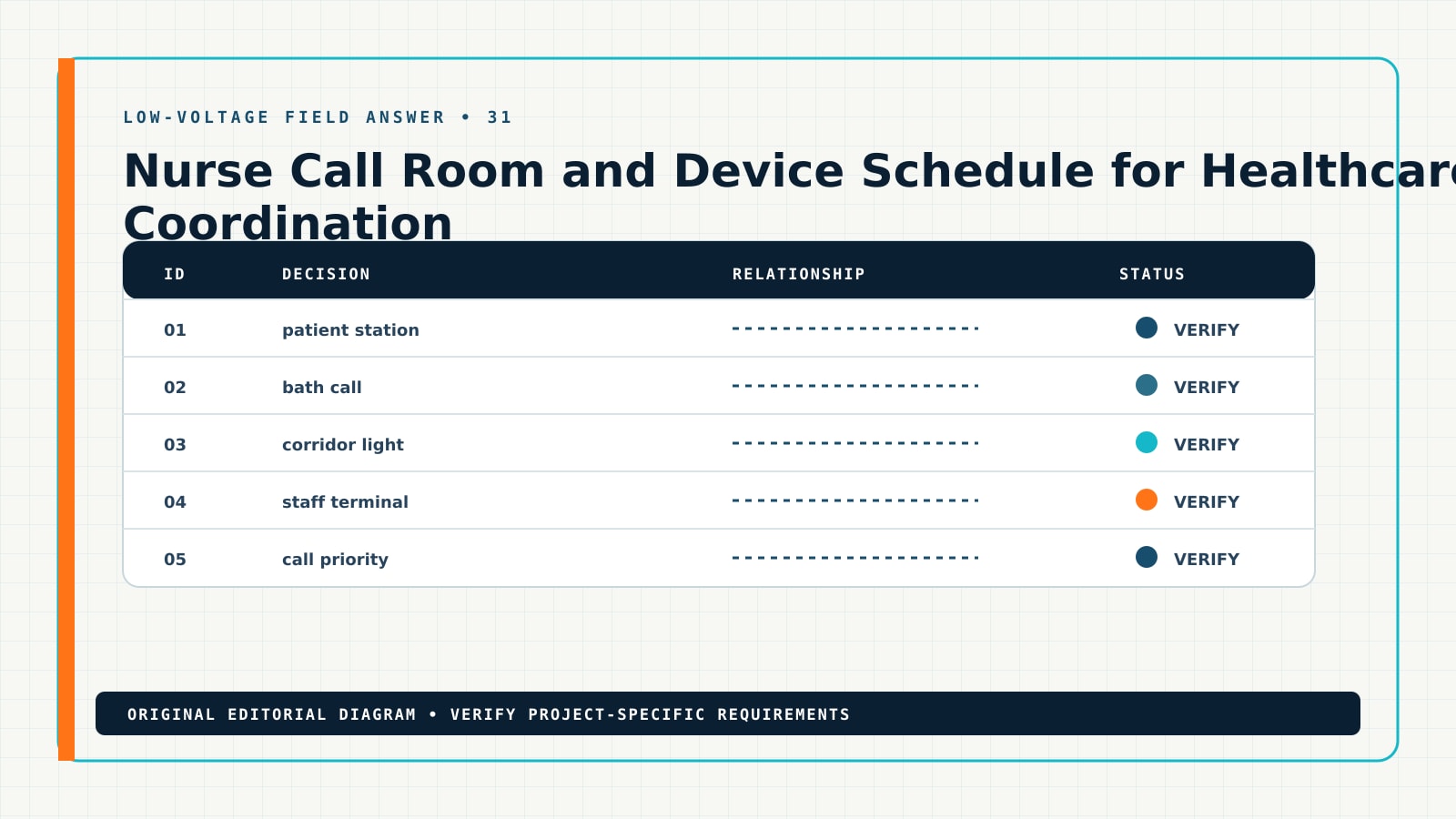
The table is an intake map. Replace generic phrases with project facts and cite their origin. When a fact is unavailable, use a field-verification item, allowance, alternate, prerequisite or exclusion; do not silently invent precision.
| Input | Decision to close | Primary record | Status example |
|---|---|---|---|
| patient station | Use approved room names, bed counts, care models, and department workflows as the baseline | Healthcare device floor plan | verified field condition |
| bath call | List every station, pull cord, pillow speaker, dome light, display, console, mobile endpoint, and interface | Room-type device matrix | manufacturer-confirmed requirement |
| corridor light | Record call types, priorities, routing, escalation, reset, presence, privacy, and accessibility behavior | Call-flow/escalation diagram | customer-approved choice |
| staff terminal | Map rooms to controllers, gateways, network, power, UPS, cable, pathways, and head-end services | Controller/network/power riser | qualified calculation input |
| call priority | Coordinate clinical operations, infection control, medical equipment, fire, phones, RTLS, IT, and facilities | Interface responsibility matrix | authority or design-team decision |
| room schedule | Test every call path, priority, escalation, annunciation, reset, outage, failover, reporting, training, and record | Clinical acceptance and training plan | explicit allowance or exclusion |
The primary record is not the only record. The design succeeds when the same identity can be traced from location to schedule, relationship diagram, quantity, proposal, field change and acceptance evidence. A change to one input should produce a visible impact review rather than an unexplained revision.
Build the answer into the drawing and project record
1. Baseline evidence: Use approved room names, bed counts, care models, and department workflows as the baseline
Capture the evidence. Tie this choice to Patient stations, pillow speakers, call cords, bath/toilet/shower devices, staff presence, code, cancel, dome lights, and room accessories. Name the source, accountable party, observation date, issue revision and its status as a verified field condition. A plausible value is not a verified value.
Place the decision. Show location and intent on the plan, repeated attributes in the schedule, and connection logic in the Patient station. Keep calculations auditable and carry commercial boundaries into the responsibility and proposal records. One stable identity should join those views.
Challenge the result. Coordinate Clinical leadership for workflows, priorities, escalation, response expectations, room use, staffing, downtime, and acceptance. Ask an estimator to trace the quantity, an installer to find the field instruction, and a reviewer to identify the acceptance evidence. Record every downstream document that changes with this input.
2. Plan and schedule: List every station, pull cord, pillow speaker, dome light, display, console, mobile endpoint, and interface
Capture the evidence. Tie this choice to Nurse consoles, duty stations, corridor displays, annunciators, mobile devices, phones, badges, reporting, and administration stations. Name the source, accountable party, observation date, issue revision and its status as a manufacturer-confirmed requirement. A plausible value is not a verified value.
Place the decision. Show location and intent on the plan, repeated attributes in the schedule, and connection logic in the Bath call device. Keep calculations auditable and carry commercial boundaries into the responsibility and proposal records. One stable identity should join those views.
Challenge the result. Coordinate Architecture for room types, headwalls, bathrooms, doors, ceilings, millwork, accessibility, infection control, and equipment clearances. Ask an estimator to trace the quantity, an installer to find the field instruction, and a reviewer to identify the acceptance evidence. Record every downstream document that changes with this input.
3. System relationship: Record call types, priorities, routing, escalation, reset, presence, privacy, and accessibility behavior
Capture the evidence. Tie this choice to Room controllers, zone controllers, servers, gateways, networks, switches, power supplies, batteries, racks, and licensing. Name the source, accountable party, observation date, issue revision and its status as a customer-approved choice. A plausible value is not a verified value.
Place the decision. Show location and intent on the plan, repeated attributes in the schedule, and connection logic in the Corridor light. Keep calculations auditable and carry commercial boundaries into the responsibility and proposal records. One stable identity should join those views.
Challenge the result. Coordinate Electrical for emergency power, circuits, batteries, grounding, panels, receptacles, shutdowns, and temporary conditions. Ask an estimator to trace the quantity, an installer to find the field instruction, and a reviewer to identify the acceptance evidence. Record every downstream document that changes with this input.
4. Shared dependency: Map rooms to controllers, gateways, network, power, UPS, cable, pathways, and head-end services
Capture the evidence. Tie this choice to Call types, priorities, tones, colors, escalation, routing, assignments, coverage, quiet hours, downtime, reports, and retention. Name the source, accountable party, observation date, issue revision and its status as a qualified calculation input. A plausible value is not a verified value.
Place the decision. Show location and intent on the plan, repeated attributes in the schedule, and connection logic in the Nurse console. Keep calculations auditable and carry commercial boundaries into the responsibility and proposal records. One stable identity should join those views.
Challenge the result. Coordinate IT for networks, servers, virtualization, cybersecurity, identity, integrations, backups, monitoring, patching, and change control. Ask an estimator to trace the quantity, an installer to find the field instruction, and a reviewer to identify the acceptance evidence. Record every downstream document that changes with this input.
5. Commercial consequence: Coordinate clinical operations, infection control, medical equipment, fire, phones, RTLS, IT, and facilities
Capture the evidence. Tie this choice to Interfaces to telephony, mobile messaging, locating, access control, EHR, beds, televisions, fire alarm, clocks, and other clinical systems. Name the source, accountable party, observation date, issue revision and its status as a authority or design-team decision. A plausible value is not a verified value.
Place the decision. Show location and intent on the plan, repeated attributes in the schedule, and connection logic in the Messaging gateway. Keep calculations auditable and carry commercial boundaries into the responsibility and proposal records. One stable identity should join those views.
Challenge the result. Coordinate Other vendors for beds, television, telephony, mobile messaging, locating, fire alarm, security, EHR, and middleware. Ask an estimator to trace the quantity, an installer to find the field instruction, and a reviewer to identify the acceptance evidence. Record every downstream document that changes with this input.
6. Acceptance evidence: Test every call path, priority, escalation, annunciation, reset, outage, failover, reporting, training, and record
Capture the evidence. Tie this choice to Cable, pathways, infection control, temporary service, programming, testing, inspections, training, documentation, support, and spares. Name the source, accountable party, observation date, issue revision and its status as a explicit allowance or exclusion. A plausible value is not a verified value.
Place the decision. Show location and intent on the plan, repeated attributes in the schedule, and connection logic in the Patient station. Keep calculations auditable and carry commercial boundaries into the responsibility and proposal records. One stable identity should join those views.
Challenge the result. Coordinate Authority, facility standards, approved products, testing, inspections, documentation, staff training, phased occupancy, and support. Ask an estimator to trace the quantity, an installer to find the field instruction, and a reviewer to identify the acceptance evidence. Record every downstream document that changes with this input.
Four-stage contractor workflow
Use progressive detail. A sales-stage plan may document purpose, location and open assumptions. A construction or regulated submittal may require product-specific calculations, licensed design, manufacturer documents and authority review. Label the stage honestly so the reader understands what may be relied upon.
- Survey. Confirm care model, room types, call types, priorities, staff roles, escalation, response, reporting, redundancy, and authority requirements. For nurse call room device schedule, preserve the location, design intent, status, owner and next field check so the drawing communicates a controlled decision rather than an anonymous symbol.
- Lay out. Place patient, bath, staff, code, corridor, console, annunciation, mobile, locating, and interface devices by approved room template. For nurse call room device schedule, preserve the location, design intent, status, owner and next field check so the drawing communicates a controlled decision rather than an anonymous symbol.
- Coordinate. Map controllers, stations, networks, gateways, power, batteries, head-end, messaging, telephony, EHR, fire, security, and workflow interfaces. For nurse call room device schedule, preserve the location, design intent, status, owner and next field check so the drawing communicates a controlled decision rather than an anonymous symbol.
- Issue. Reconcile equipment, cable, licensing, programming, infection-control work, testing, training, records, spares, and proposal scope. For nurse call room device schedule, preserve the location, design intent, status, owner and next field check so the drawing communicates a controlled decision rather than an anonymous symbol.
What must remain synchronized
The controlling baseline, Healthcare device floor plan, Room-type device matrix, Call-flow/escalation diagram, Controller/network/power riser, quantity basis, proposal scope, field copy, change log and closeout record should describe the same issued decision. If they do not, stop and reconcile them before procurement or installation.
Worked field scenario: medical-surgical floor renovation
Starting condition. room symbols are copied from an old plan without matching the new care workflow.
Contractor response. The team applies the six decision groups above, assigns stable identities, marks unknowns, connects the focused answer to Architecture for room types, headwalls, bathrooms, doors, ceilings, millwork, accessibility, infection control, and equipment clearances, and issues the affected plan, schedule, relationship and quantity records together.
Outcome. the room schedule exposes different device and call requirements before rough-in. The customer can see what is included, what another party must provide, what remains to be verified, and how acceptance will be demonstrated.
Example traceability chain
- Outcome: state the operating result in customer language.
- Evidence: attach the measurement, photograph, survey note, approved selection, product data or authority direction that controls the decision.
- Design: show the location, identity, attributes and system relationship on the appropriate documents.
- Quantity: connect equipment, accessories, cable, pathway, labor, licensing, configuration and testing to the issued revision.
- Acceptance: define the observation, measurement, function, report or approval that closes the requirement.
Common failure modes and how to correct them
| Failure | Why it matters | Corrective action |
|---|---|---|
| the input was assumed but presented as verified | It breaks traceability for patient station and can move risk into estimating, installation or acceptance without an owner. | Use approved room names, bed counts, care models, and department workflows as the baseline; then reissue affected records under one revision. |
| the floor plan and schedule use different identities | It breaks traceability for bath call and can move risk into estimating, installation or acceptance without an owner. | List every station, pull cord, pillow speaker, dome light, display, console, mobile endpoint, and interface; then reissue affected records under one revision. |
| a shared pathway, network, power or trade dependency has no owner | It breaks traceability for corridor light and can move risk into estimating, installation or acceptance without an owner. | Record call types, priorities, routing, escalation, reset, presence, privacy, and accessibility behavior; then reissue affected records under one revision. |
| the estimate uses a quantity that cannot be traced to an issued drawing | It breaks traceability for staff terminal and can move risk into estimating, installation or acceptance without an owner. | Map rooms to controllers, gateways, network, power, UPS, cable, pathways, and head-end services; then reissue affected records under one revision. |
| a product-specific limit was replaced with a generic rule of thumb | It breaks traceability for call priority and can move risk into estimating, installation or acceptance without an owner. | Coordinate clinical operations, infection control, medical equipment, fire, phones, RTLS, IT, and facilities; then reissue affected records under one revision. |
| the closeout test proves installation but not the required operating outcome | It breaks traceability for room schedule and can move risk into estimating, installation or acceptance without an owner. | Test every call path, priority, escalation, annunciation, reset, outage, failover, reporting, training, and record; then reissue affected records under one revision. |
Correction is not merely adding another note. Identify the controlling source, update the proper document, propagate the change to dependent quantities and scope, notify responsible parties, and preserve what changed. That is what turns a technically correct answer into a reliable contractor workflow.
Pre-proposal audit checklist
- patient station: find its location and identity on the controlling record, confirm who approved it, and trace the same intent through schedule, system relationship, quantity, proposal and acceptance evidence.
- bath call: find its location and identity on the controlling record, confirm who approved it, and trace the same intent through schedule, system relationship, quantity, proposal and acceptance evidence.
- corridor light: find its location and identity on the controlling record, confirm who approved it, and trace the same intent through schedule, system relationship, quantity, proposal and acceptance evidence.
- staff terminal: find its location and identity on the controlling record, confirm who approved it, and trace the same intent through schedule, system relationship, quantity, proposal and acceptance evidence.
- call priority: find its location and identity on the controlling record, confirm who approved it, and trace the same intent through schedule, system relationship, quantity, proposal and acceptance evidence.
- room schedule: find its location and identity on the controlling record, confirm who approved it, and trace the same intent through schedule, system relationship, quantity, proposal and acceptance evidence.
- Shared infrastructure: name the owner of rooms, racks, pathways, network, power, UPS, grounding, firestopping, accounts, licenses and support.
- Revision: confirm the customer-facing proposal cites the same drawing and schedule revision used for quantities.
- Boundary: distinguish contractor coordination from engineering, permitting, code review, cybersecurity, privacy, accessibility and authority approval.
- Acceptance: describe what will be observed, measured, demonstrated, documented and approved—not only that equipment will be installed.
If any answer is missing, assign it. A named open item is manageable; an invisible assumption is not. Use alternates when the customer must choose between documented approaches, allowances when quantity or condition cannot yet be verified, and exclusions only when the boundary is explicit and commercially understood.
Turn the answer into customer-readable scope
A professional proposal should cite the project and revision, summarize the outcome, list included deliverables, explain major quantities, identify infrastructure and third-party dependencies, state assumptions, distinguish owner-furnished items, and define tests and closeout. It should not paste this article or bury technical uncertainty in fine print.
Write inclusions around work products: survey verification, plan updates, equipment and accessory schedules, cable and pathway scope, configuration, programming, testing, training, as-builts and support. Write exclusions around clear responsibility boundaries. If a dependency could stop the system from working—such as internet, VLANs, door hardware, power, structure, permits or manufacturer services—place it near the related scope and assign an owner.
Continue through the Nurse Call & Healthcare topic cluster
This page answers one focused question. Use the connected resources to move from the immediate answer into the complete design, documentation and commercial workflow.
- Nurse Call System Design Software for Healthcare Plans — the canonical software and workflow page for this industry.
- Nurse Call Infrastructure Checklist: Network, Power, Pathways and Interfaces — the paired field answer for the next common decision.
- nurse call coordination guide — related implementation guidance already maintained in this publication.
- cable schedule guide — related implementation guidance already maintained in this publication.
- telecom-room guide — related implementation guidance already maintained in this publication.
- Low-voltage design software by industry — compare all 22 specialist workflows.
- Low-voltage design disciplines — choose the technical documents and interfaces behind the system.
Authoritative references and verification boundary
Use current editions, adopted requirements, approved submittals and exact manufacturer instructions for the actual project. The sources below provide useful primary context, but no public article can decide project-specific licensing, engineering responsibility, code compliance, cybersecurity, privacy, accessibility, product compatibility or authority acceptance.
- UL Healthcare Certifications — healthcare product and system safety context.
- HHS Health Industry Cybersecurity Practices — healthcare cybersecurity practices.
- FGI Guidelines — healthcare facility design guidance context.
Frequently asked questions
What is the fastest reliable way to start nurse call room device schedule?
Start by writing the operating outcome and collecting the evidence that controls it. Build the IDs and schedule before drawing anonymous symbols. Mark every important input as verified, selected, assumed, excluded or assigned, then connect it to a plan, relationship diagram, quantity and acceptance check.
What should be included in the project record?
At minimum, preserve the verified baseline, stable identities, the six decision groups on this page, shared infrastructure and responsibilities, product-specific requirements, quantity basis, revision status, test evidence and closeout updates. The exact set depends on the contract, system risk and responsible designer.
Can a generic rule of thumb replace manufacturer or code requirements?
No. Rules of thumb may help compare early options, but final decisions must use the adopted requirements, approved equipment data, actual route or geometry, responsible professional review and authority process that apply to the project.
How should this answer affect a proposal?
Turn unresolved facts into named qualifications rather than hidden risk. Include the controlling drawing revision, traceable quantities, responsibilities, prerequisites, allowances, alternatives, exclusions, testing and acceptance. When the design changes, issue the quantity and commercial impact together.
What should I read next?
Open Nurse Call Infrastructure Checklist: Network, Power, Pathways and Interfaces for the paired industry problem, then use the canonical Nurse Call & Healthcare workflow page to connect the answer to a complete plan, proposal and field handoff.