
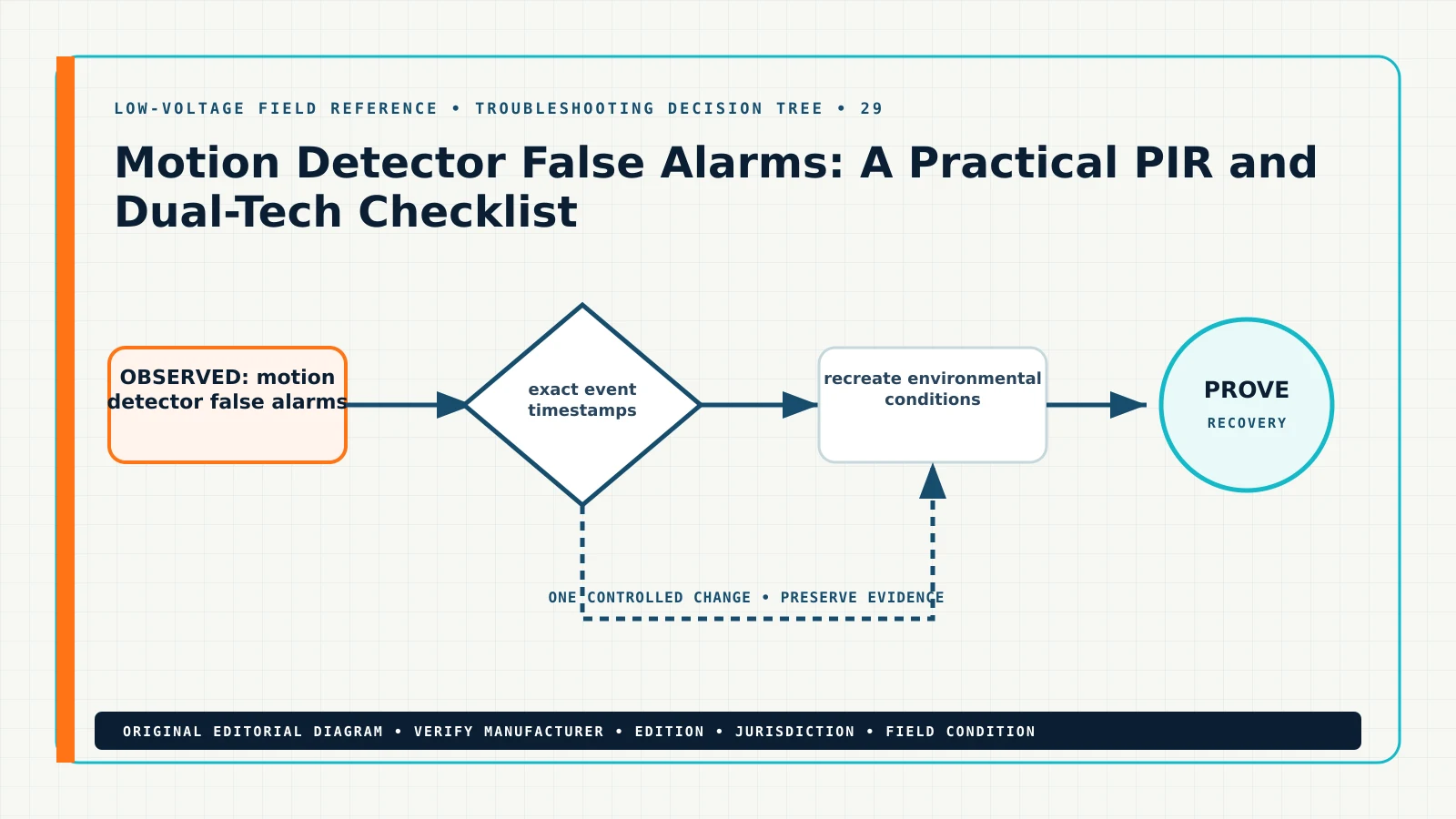
Low-Voltage Field Reference • Troubleshooting decision tree
Motion Detector False Alarms: A Practical PIR and Dual-Tech Checklist
False alarms are solved by matching event time and zone evidence to environment, placement, wiring, power, sensitivity and detector technology. Do not mask the symptom by reducing sensitivity until the coverage objective is reverified.
Direct answer
motion detector false alarm troubleshooting: the practical answer
False alarms are solved by matching event time and zone evidence to environment, placement, wiring, power, sensitivity and detector technology. Do not mask the symptom by reducing sensitivity until the coverage objective is reverified.
For a working contractor, the value of this decision tree is its ability to isolate one layer at a time while preserving useful evidence. Use the sequence symptom → baseline → isolation → correction → regression test. Do not reset, replace or reconfigure multiple elements before recording the baseline.
What this changes in the design package
Motion Detector False Alarms: A Practical PIR and Dual-Tech Checklist should change at least one controlled project record. On a floor plan, identify the physical location or route affected by exact event timestamps and zone and device identity. On the riser or signal-flow drawing, show how the selected equipment, pathway, power and communications relationships support the intended outcome. In the schedule, preserve the exact data needed to buy, configure, install and test the system.
Plan
Show the device, route, zone or interface in context. Use stable IDs rather than relying on a symbol alone, and flag any assumption that can change quantity or performance.
Riser or schematic
Show origin, destination, intervening equipment, shared infrastructure and interface responsibility. A diagram should expose relationships the floor plan cannot show clearly.
Schedule
Record coverage objective, temperature and airflow conditions, moving objects and animals and voltage and resistance readings where they can be reviewed and revised without redrawing the entire plan.
Proposal
State the verified design basis, named allowances, exclusions, owner/IT/electrical dependencies, testing method and the event that triggers a change order.
Field method
A repeatable decision tree workflow
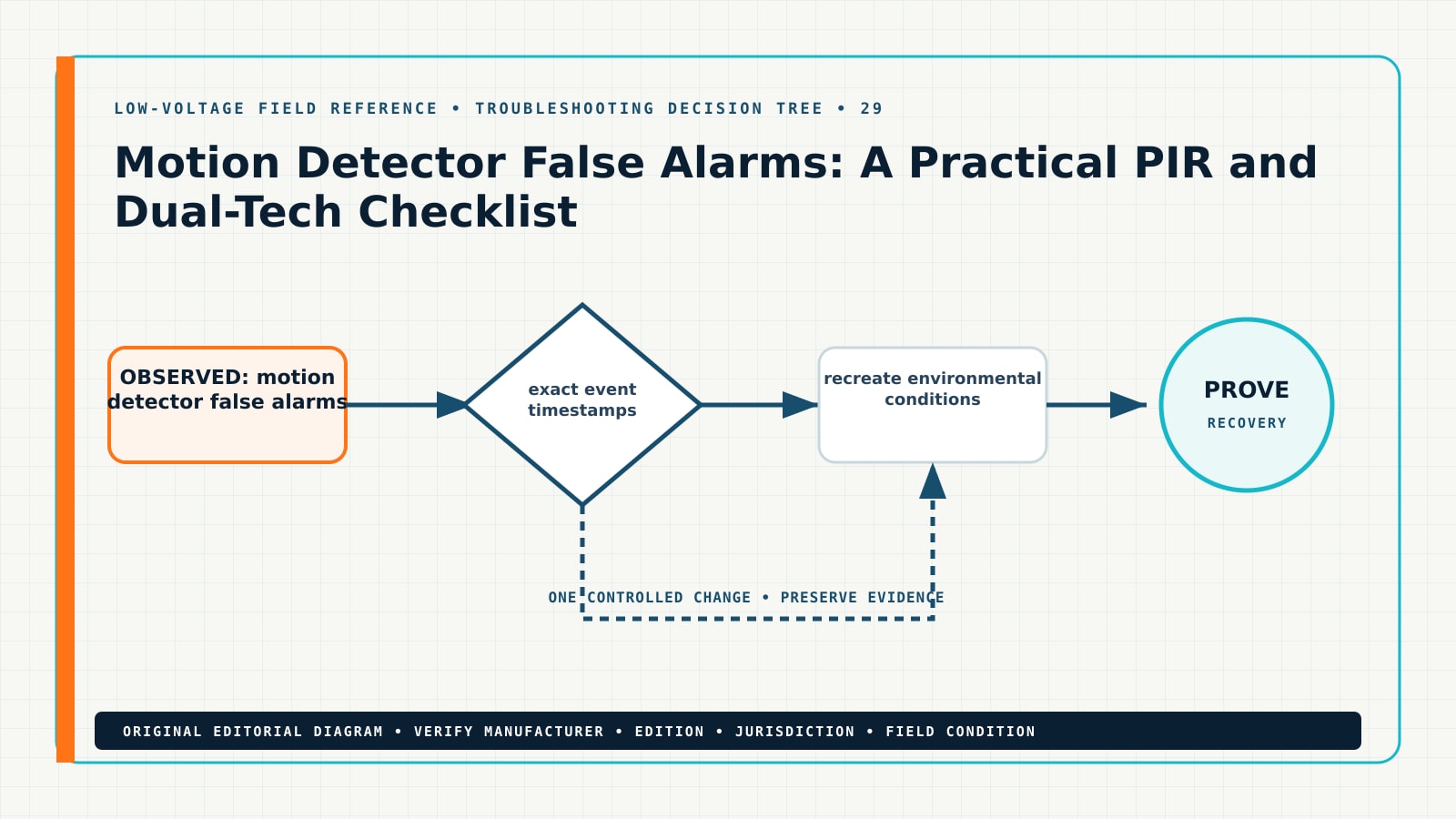
Capture the symptom and timestamps before touching the system. Move from the lowest physical layer upward, changing one controlled variable at a time.
- 1. recreate environmental conditions.
- 2. walk-test from intended and excluded areas.
- 3. inspect mounting stability and lens condition.
- 4. review zone programming and supervision.
- 5. monitor after one controlled change.
After the final step, repeat the original operating scenario. A correction is not complete until the system passes the required function, the drawing and schedule match the installed condition, and the handoff record identifies what changed.
Decision and evidence table
| Question | Evidence to collect | Where to record it | Acceptance signal |
|---|---|---|---|
| What controls exact event timestamps? | recreate environmental conditions; use exact model, reading, setting, photo or log evidence. | false-alarm incident record, keyed to the same device/cable/door/zone ID. | The reviewed record and field condition agree, with no unresolved assumption hidden as fact. |
| What controls zone and device identity? | walk-test from intended and excluded areas; use exact model, reading, setting, photo or log evidence. | coverage sketch, keyed to the same device/cable/door/zone ID. | The reviewed record and field condition agree, with no unresolved assumption hidden as fact. |
| What controls coverage objective? | inspect mounting stability and lens condition; use exact model, reading, setting, photo or log evidence. | final settings record, keyed to the same device/cable/door/zone ID. | The reviewed record and field condition agree, with no unresolved assumption hidden as fact. |
| What controls temperature and airflow conditions? | review zone programming and supervision; use exact model, reading, setting, photo or log evidence. | post-correction observation log, keyed to the same device/cable/door/zone ID. | The reviewed record and field condition agree, with no unresolved assumption hidden as fact. |
Keep evidence close to the decision it supports. A screenshot without an equipment ID, a cable test without the cable identifier, or a code note without edition and jurisdiction is difficult to audit later.
Technical deep dive
Six controls that make motion detector false alarms defensible
1. exact event timestamps
challenge exact event timestamps before the team commits PIR false alarm to the drawing. Identify who supplied the value, how current it is, which exact device, cable, interface, door, zone or route it controls, and what would invalidate it. If the answer comes from a product sheet, retain the model and revision. If it comes from a field observation, retain the location, timestamp, instrument or screen, and technician. If it comes from a requirement, retain jurisdiction, edition and reviewer.
Use this checkpoint to recreate environmental conditions. Compare the evidence with the intended intrusion detection outcome and the accepted project baseline. A discrepancy should become a named issue with an owner and due date; it should not be buried in a markup. Watch specifically for changing multiple settings at once, because that failure can create a plausible-looking plan while breaking the installation, test or commercial handoff.
Close the checkpoint in the false-alarm incident record. Tie it to motion detector false alarms and PIR false alarm with the same stable identifier used on the plan and schedule. The reviewer should be able to see the source, selected value, status, exception and acceptance result without reconstructing the designer’s assumptions from email.
2. zone and device identity
preserve zone and device identity before the team commits dual technology detector to the drawing. Identify who supplied the value, how current it is, which exact device, cable, interface, door, zone or route it controls, and what would invalidate it. If the answer comes from a product sheet, retain the model and revision. If it comes from a field observation, retain the location, timestamp, instrument or screen, and technician. If it comes from a requirement, retain jurisdiction, edition and reviewer.
Use this checkpoint to walk-test from intended and excluded areas. Compare the evidence with the intended intrusion detection outcome and the accepted project baseline. A discrepancy should become a named issue with an owner and due date; it should not be buried in a markup. Watch specifically for placing detectors near moving air or sunlight without review, because that failure can create a plausible-looking plan while breaking the installation, test or commercial handoff.
Close the checkpoint in the coverage sketch. Tie it to motion detector false alarms and dual technology detector with the same stable identifier used on the plan and schedule. The reviewer should be able to see the source, selected value, status, exception and acceptance result without reconstructing the designer’s assumptions from email.
3. coverage objective
establish coverage objective before the team commits alarm zone trouble to the drawing. Identify who supplied the value, how current it is, which exact device, cable, interface, door, zone or route it controls, and what would invalidate it. If the answer comes from a product sheet, retain the model and revision. If it comes from a field observation, retain the location, timestamp, instrument or screen, and technician. If it comes from a requirement, retain jurisdiction, edition and reviewer.
Use this checkpoint to inspect mounting stability and lens condition. Compare the evidence with the intended intrusion detection outcome and the accepted project baseline. A discrepancy should become a named issue with an owner and due date; it should not be buried in a markup. Watch specifically for ignoring loose terminals and power faults, because that failure can create a plausible-looking plan while breaking the installation, test or commercial handoff.
Close the checkpoint in the final settings record. Tie it to motion detector false alarms and alarm zone trouble with the same stable identifier used on the plan and schedule. The reviewer should be able to see the source, selected value, status, exception and acceptance result without reconstructing the designer’s assumptions from email.
4. temperature and airflow conditions
measure temperature and airflow conditions before the team commits motion sensor placement to the drawing. Identify who supplied the value, how current it is, which exact device, cable, interface, door, zone or route it controls, and what would invalidate it. If the answer comes from a product sheet, retain the model and revision. If it comes from a field observation, retain the location, timestamp, instrument or screen, and technician. If it comes from a requirement, retain jurisdiction, edition and reviewer.
Use this checkpoint to review zone programming and supervision. Compare the evidence with the intended intrusion detection outcome and the accepted project baseline. A discrepancy should become a named issue with an owner and due date; it should not be buried in a markup. Watch specifically for closing the issue without a monitored period, because that failure can create a plausible-looking plan while breaking the installation, test or commercial handoff.
Close the checkpoint in the post-correction observation log. Tie it to motion detector false alarms and motion sensor placement with the same stable identifier used on the plan and schedule. The reviewer should be able to see the source, selected value, status, exception and acceptance result without reconstructing the designer’s assumptions from email.
5. moving objects and animals
trace moving objects and animals before the team commits intrusion event log to the drawing. Identify who supplied the value, how current it is, which exact device, cable, interface, door, zone or route it controls, and what would invalidate it. If the answer comes from a product sheet, retain the model and revision. If it comes from a field observation, retain the location, timestamp, instrument or screen, and technician. If it comes from a requirement, retain jurisdiction, edition and reviewer.
Use this checkpoint to monitor after one controlled change. Compare the evidence with the intended intrusion detection outcome and the accepted project baseline. A discrepancy should become a named issue with an owner and due date; it should not be buried in a markup. Watch specifically for changing multiple settings at once, because that failure can create a plausible-looking plan while breaking the installation, test or commercial handoff.
Close the checkpoint in the false-alarm incident record. Tie it to motion detector false alarms and intrusion event log with the same stable identifier used on the plan and schedule. The reviewer should be able to see the source, selected value, status, exception and acceptance result without reconstructing the designer’s assumptions from email.
6. voltage and resistance readings
reconcile voltage and resistance readings before the team commits motion detector false alarms to the drawing. Identify who supplied the value, how current it is, which exact device, cable, interface, door, zone or route it controls, and what would invalidate it. If the answer comes from a product sheet, retain the model and revision. If it comes from a field observation, retain the location, timestamp, instrument or screen, and technician. If it comes from a requirement, retain jurisdiction, edition and reviewer.
Use this checkpoint to recreate environmental conditions. Compare the evidence with the intended intrusion detection outcome and the accepted project baseline. A discrepancy should become a named issue with an owner and due date; it should not be buried in a markup. Watch specifically for placing detectors near moving air or sunlight without review, because that failure can create a plausible-looking plan while breaking the installation, test or commercial handoff.
Close the checkpoint in the coverage sketch. Tie it to motion detector false alarms and motion detector false alarms with the same stable identifier used on the plan and schedule. The reviewer should be able to see the source, selected value, status, exception and acceptance result without reconstructing the designer’s assumptions from email.
Field-capture worksheet
Before leaving the site, collect enough evidence that another qualified person can reconstruct the decision. Start with the site, floor, room and stable asset ID. Record the date, technician and current drawing revision. Photograph the overall context before taking close-ups, and place a readable label or reference in the image when practical.
- Identity
- Exact manufacturer, model, firmware or listing, terminal names, cable ID, panel/port/zone/door address, and the related plan symbol.
- Observed state
- What the user reported, what the technician reproduced, timestamps, LEDs or messages, logs, settings and whether the condition is continuous or intermittent.
- Measured state
- Applicable voltage, current, resistance, optical level, cable result, protocol status, signal format or environmental condition, including the instrument and test boundary.
- Change control
- The one change made, authorization, before/after evidence, temporary workaround, regression checks and any effect on other devices or shared infrastructure.
For this topic, call out exact event timestamps, coverage objective and moving objects and animals. Use the vocabulary motion detector false alarms, PIR false alarm, dual technology detector consistently so the field note, drawing, schedule and proposal can be found together.
Worked field example
From an uncertain condition to a controlled record
A renovation team receives a report involving motion detector false alarms. The available plan shows a symbol, but it does not identify exact event timestamps, zone and device identity or coverage objective. Instead of pricing or repairing from the incomplete symbol, the team opens a single issue record and assigns the affected equipment, cable or location a stable ID.
The technician collects the current settings, model information, photos and measured state. The designer compares that evidence with the selected equipment documentation and the current authoritative sources listed below. The estimator separates verified scope from allowances. The project manager records who owns any external dependency, such as an electrical circuit, network policy, door hardware condition, AHJ decision or owner-furnished device.
The corrected package includes the false-alarm incident record, coverage sketch and final settings record. The team then repeats the operating test under the same conditions that produced the original question. That closed loop turns PIR false alarm and dual technology detector from search terms into traceable project decisions instead of isolated notes.
Common failure modes—and why they happen
Failure 01
changing multiple settings at once
This shortcut removes context from the decision. Correct it by returning to the project-specific input, documenting the selected basis, and repeating the affected acceptance test.
Failure 02
placing detectors near moving air or sunlight without review
This shortcut removes context from the decision. Correct it by returning to the project-specific input, documenting the selected basis, and repeating the affected acceptance test.
Failure 03
ignoring loose terminals and power faults
This shortcut removes context from the decision. Correct it by returning to the project-specific input, documenting the selected basis, and repeating the affected acceptance test.
Failure 04
closing the issue without a monitored period
This shortcut removes context from the decision. Correct it by returning to the project-specific input, documenting the selected basis, and repeating the affected acceptance test.
When a failure involves regulated life safety, egress, listing, energized work, public-safety radio, or code interpretation, stop at the boundary of your authorization. Escalate to the responsible qualified party and preserve the condition and evidence.
Minimum contractor deliverables
A useful answer survives the handoff from design to estimating, proposal, installation and closeout. At minimum, create the following:
- false-alarm incident record.
- coverage sketch.
- final settings record.
- post-correction observation log.
Each deliverable should show the project, revision, author, review status and the identity of the system element it controls. If a value is not verified, label it as an assumption, allowance, pending submittal or owner/AHJ decision. Do not let a blank field become an accidental commitment.
How to carry the answer into scope and proposal language
Describe the outcome first: what the customer will receive, where it applies and how it will be tested. Then name the basis used for motion detector false alarms, including the controlling drawing revision and selected equipment data. Include the labor and documentation needed to produce false-alarm incident record and coverage sketch.
Separate dependencies explicitly. Examples include usable owner drawings, accessible ceilings, working branch power, network addressing and policy, compatible owner equipment, door hardware readiness, permits, shutdown windows, AHJ review and access to occupied areas. If one of those facts is unknown, write an allowance or qualification and define how the price changes when the fact is confirmed.
Finish with acceptance: identify who witnesses the test, what evidence is retained and which result constitutes completion. This makes the page commercially useful without turning it into a product pitch.
Commissioning, handoff and future service
Commissioning should prove the designed function, not simply show that equipment turns on. Run the accepted scenario, an expected failure or trouble state, recovery, and any interface that crosses to network, electrical, fire alarm, door hardware, controls or owner systems. Save results against stable IDs and the approved revision.
At handoff, give the owner the false-alarm incident record, coverage sketch, final configuration, approved substitutions, warranties and the contact path for unresolved external responsibilities. Remove default credentials and temporary access where applicable. Explain which changes can invalidate the result—for example a new firmware release, equipment replacement, changed speaker tap, moved camera, added cable, revised AHJ direction or modified switch policy.
Future service begins by comparing the current condition with this accepted baseline. If the record is missing, recreate it before making broad changes. That discipline reduces repeated troubleshooting, protects proposal scope, and lets the next technician distinguish a design issue from a later operational change.
Frequently asked questions
What should I verify first?
Start with exact event timestamps and zone and device identity. Establish the exact product, project location and current system state before applying a diagram or changing configuration.
Can I use this page as a construction detail?
Use it as an editorial planning and verification aid. Convert it into a project detail only after reconciling the manufacturer instructions, adopted requirements, approved submittals and responsible professional or AHJ direction.
What belongs in the closeout package?
Include false-alarm incident record, coverage sketch, final settings record, post-correction observation log, plus test evidence, deviations, final settings and the identity of the person or authority that accepted the result.
What should I read next?
Continue with PoE Security Camera Offline: A Layer-by-Layer Troubleshooting Guide, NVR Shows Camera Connected but No Image: Troubleshooting Flow, Access Reader Beeps but Door Will Not Unlock: Diagnostic Decision Tree, OSDP Reader Offline: Address, Polarity, Power and Secure Channel Checks and the Intrusion Detection design software resource.
Authoritative references and how to use them
These links are starting points for current primary-source information. Confirm the current edition, product revision, publication status, jurisdiction and applicability. Accessed for this release on 2026-08-08.
- Security Industry Association OSDP — use the source to verify terminology, conformance, published requirements or manufacturer-specific behavior; do not substitute this summary for the controlling document.
- CISA Secure by Design — use the source to verify terminology, conformance, published requirements or manufacturer-specific behavior; do not substitute this summary for the controlling document.
- UL Standards and Engagement — use the source to verify terminology, conformance, published requirements or manufacturer-specific behavior; do not substitute this summary for the controlling document.