
Intrusion Detection contractor resource
Intrusion Alarm Design Software for Zones and Device Plans
Translate protection goals into zones, sensors, contacts, keypads, panels, communications, power, wiring, monitoring, test procedures, and customer scope. This practical guide explains what to document, how to structure the drawing set, where coordination fails, what the proposal must carry, and how to evaluate software against a real contractor workflow.
What intrusion alarm system design software must solve
Someone searching for intrusion alarm system design software is rarely looking for a generic drawing program. The practical need is a controlled way to translate customer intent and field conditions into a design another estimator, installer, reviewer, programmer, IT administrator, and customer can understand. The software must help the contractor preserve decisions as the project moves from discovery to proposal and from approved scope to installation.
For intrusion detection, the core promise is specific: Translate protection goals into zones, sensors, contacts, keypads, panels, communications, power, wiring, monitoring, test procedures, and customer scope. That means the plan cannot be an attractive background with unconnected icons. Each important item needs a stable identity and a reason to exist. Its location must agree with schedules and schematics; its infrastructure must be visible; its quantity must reach the estimate; and its open decisions must be owned.
The best result is query-complete rather than keyword-heavy. A customer should be able to use this page to understand the deliverables, ask better questions, recognize missing scope, and select a workflow. A contractor should be able to turn the same guidance into a survey checklist, drawing outline, coordination meeting agenda, estimating review, and acceptance plan.
The design record should answer six groups of questions
The table below connects the design scope to a reviewable output. The exact document set depends on project size, contract, jurisdiction, risk, and the responsible designer. The principle stays the same: put information where it can be checked and cross-reference it with stable identifiers.
| Decision group | What to document | Useful output |
|---|---|---|
| Perimeter openings, interior spaces | Perimeter openings, interior spaces, high-value areas, duress points, environmental conditions, and operating modes | Intrusion device floor plan |
| Contacts, motions | Contacts, motions, glassbreak, beam, shock, panic, keypad, sounder, and specialty sensor purpose and placement | Zone and device schedule |
| Zone, loop | Zone, loop, input, address, partition, area, bypass, alarm, trouble, supervision, and response relationships | Panel/power/communications riser |
| Panel, expander | Panel, expander, power, batteries, communicator, network/cellular path, enclosure, capacity, and tamper protection | Partition and response matrix |
| Cable, pathway | Cable, pathway, end-of-line, isolation, surge, labeling, testing, monitoring, and service documentation | Cable schedule |
| Programming, app/user setup | Programming, app/user setup, verification, permits, monitoring agreement, training, maintenance, and exclusions | Test and customer-training checklist |
Recommended deliverables
Intrusion device floor plan
Intrusion device floor plan. Record the value, source, verification status, responsible party, and revision so another person can audit the decision.
Zone and device schedule
Zone and device schedule. Show the relationship on the correct drawing or schedule instead of burying it in a note that cannot be traced.
Panel/power/communications riser
Panel/power/communications riser. Separate observed conditions from design assumptions and customer choices; price uncertainty as an allowance or exclusion when needed.
Partition and response matrix
Partition and response matrix. Carry stable identifiers into the takeoff, proposal, installation record, test evidence, and closeout documents.
Cable schedule
Cable schedule. Review capacity, compatibility, access, serviceability, future change, and failure behavior before the product is committed.
Test and customer-training checklist
Test and customer-training checklist. Assign ownership at the interface with architecture, electrical, IT, operations, other vendors, and the authority having jurisdiction.
A floor plan is usually the location index, not the entire design. When lines or notes make it hard to answer a question, move the information to the proper schedule, schematic, riser, elevation, matrix, narrative, or calculation worksheet. Then place a clear reference on both documents so the reader can move between them.
Intrusion Detection project review worksheet
Use these six prompts during discovery, drawing review, estimating, and handoff. Write the answer in project language, identify its source, and mark whether it is verified, selected, assumed, excluded, or assigned to another party.
1. Survey evidence
Review this system-specific scope: Perimeter openings, interior spaces, high-value areas, duress points, environmental conditions, and operating modes.
Connect it to this coordination condition: Door and window types, contacts, frames, hardware, glazing, roll-up doors, roof access, and building envelope. The review is complete only when the plan, Intrusion device floor plan, quantity basis, responsibility, and verification record describe the same decision. If the answer depends on a field condition, product selection, authority, owner policy, or third-party system, name that dependency instead of converting it into an unsupported promise.
2. Drawing decision
Review this system-specific scope: Contacts, motions, glassbreak, beam, shock, panic, keypad, sounder, and specialty sensor purpose and placement.
Connect it to this coordination condition: Sensor technology, range, mounting, masking, pets, HVAC, sunlight, vibration, stock, partitions, and environmental conditions. The review is complete only when the plan, Zone and device schedule, quantity basis, responsibility, and verification record describe the same decision. If the answer depends on a field condition, product selection, authority, owner policy, or third-party system, name that dependency instead of converting it into an unsupported promise.
3. Infrastructure dependency
Review this system-specific scope: Zone, loop, input, address, partition, area, bypass, alarm, trouble, supervision, and response relationships.
Connect it to this coordination condition: User schedules, arming process, partitions, cleaning, deliveries, duress, after-hours access, and response expectations. The review is complete only when the plan, Panel/power/communications riser, quantity basis, responsibility, and verification record describe the same decision. If the answer depends on a field condition, product selection, authority, owner policy, or third-party system, name that dependency instead of converting it into an unsupported promise.
4. Commercial consequence
Review this system-specific scope: Panel, expander, power, batteries, communicator, network/cellular path, enclosure, capacity, and tamper protection.
Connect it to this coordination condition: Monitoring station, communicator, cellular/network service, permits, verification, dispatch policy, and false-alarm requirements. The review is complete only when the plan, Partition and response matrix, quantity basis, responsibility, and verification record describe the same decision. If the answer depends on a field condition, product selection, authority, owner policy, or third-party system, name that dependency instead of converting it into an unsupported promise.
5. Field verification
Review this system-specific scope: Cable, pathway, end-of-line, isolation, surge, labeling, testing, monitoring, and service documentation.
Connect it to this coordination condition: Panel and power location, batteries, circuits, pathways, surge, grounding, network, cybersecurity, and service access. The review is complete only when the plan, Cable schedule, quantity basis, responsibility, and verification record describe the same decision. If the answer depends on a field condition, product selection, authority, owner policy, or third-party system, name that dependency instead of converting it into an unsupported promise.
6. Acceptance evidence
Review this system-specific scope: Programming, app/user setup, verification, permits, monitoring agreement, training, maintenance, and exclusions.
Connect it to this coordination condition: Existing-system reuse, device compatibility, takeover limits, warranties, programming ownership, records, and maintenance. The review is complete only when the plan, Test and customer-training checklist, quantity basis, responsibility, and verification record describe the same decision. If the answer depends on a field condition, product selection, authority, owner policy, or third-party system, name that dependency instead of converting it into an unsupported promise.
Trace one intrusion detection decision through the record
For a neighborhood pharmacy with public sales space, stockroom, office, rear delivery door, and controlled drug storage, use the following chain as a document-control exercise. The entries are not generic fields: each one ties a discipline-specific design question to a deliverable and a commercial or field consequence.
| Design question | Primary record | Traceability test |
|---|---|---|
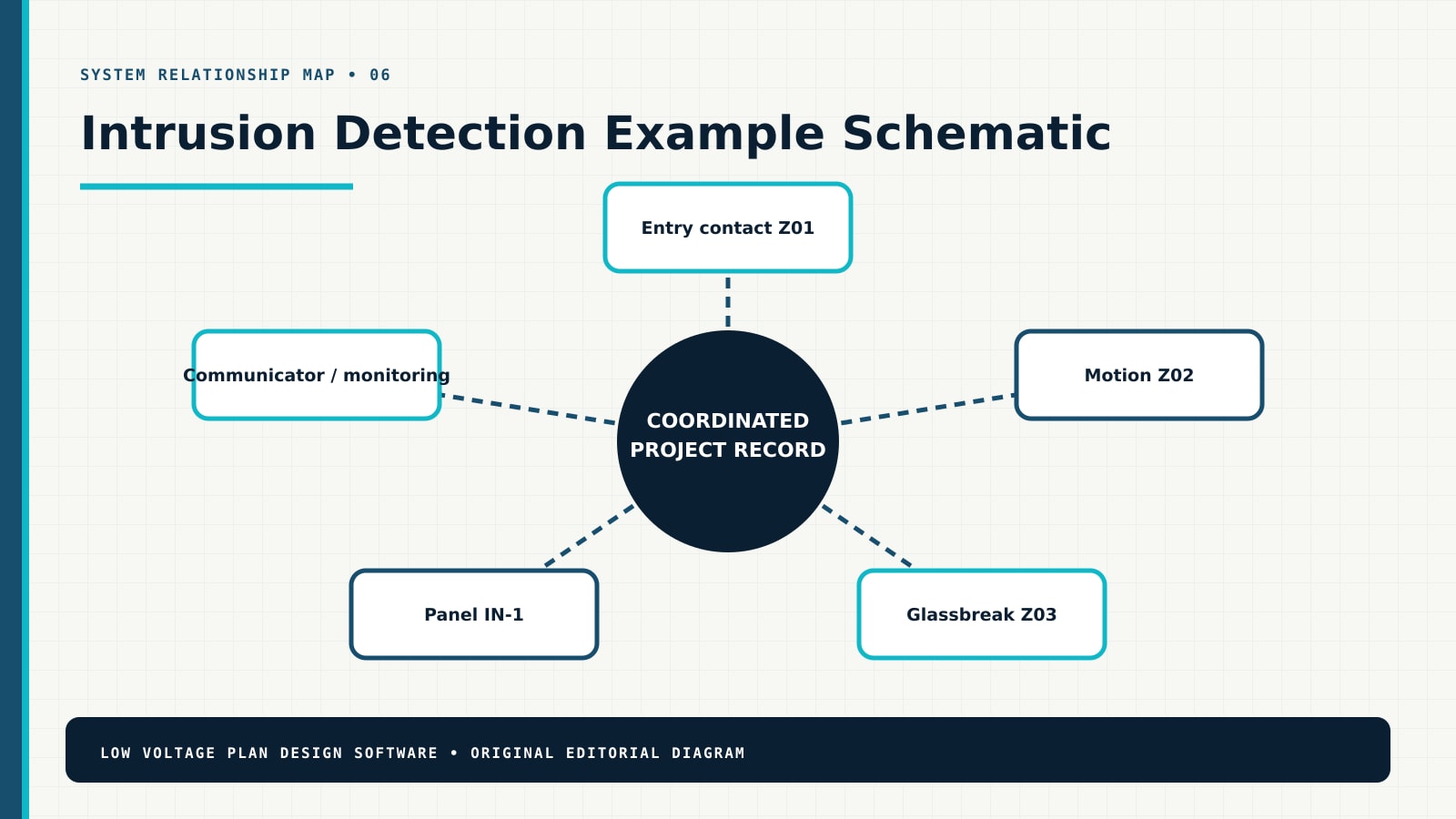
| Perimeter openings, interior spaces, high-value areas, duress points, environmental conditions, and operating modes | Intrusion device floor plan | Find the matching Entry contact Z01 relationship, then identify the quantity, owner, verification status, and effect of a revision to Door and window types, contacts, frames, hardware, glazing, roll-up doors, roof access, and building envelope. |
| Contacts, motions, glassbreak, beam, shock, panic, keypad, sounder, and specialty sensor purpose and placement | Zone and device schedule | Find the matching Motion Z02 relationship, then identify the quantity, owner, verification status, and effect of a revision to Sensor technology, range, mounting, masking, pets, HVAC, sunlight, vibration, stock, partitions, and environmental conditions. |
| Zone, loop, input, address, partition, area, bypass, alarm, trouble, supervision, and response relationships | Panel/power/communications riser | Find the matching Glassbreak Z03 relationship, then identify the quantity, owner, verification status, and effect of a revision to User schedules, arming process, partitions, cleaning, deliveries, duress, after-hours access, and response expectations. |
| Panel, expander, power, batteries, communicator, network/cellular path, enclosure, capacity, and tamper protection | Partition and response matrix | Find the matching Panel IN-1 relationship, then identify the quantity, owner, verification status, and effect of a revision to Monitoring station, communicator, cellular/network service, permits, verification, dispatch policy, and false-alarm requirements. |
| Cable, pathway, end-of-line, isolation, surge, labeling, testing, monitoring, and service documentation | Cable schedule | Find the matching Communicator / monitoring relationship, then identify the quantity, owner, verification status, and effect of a revision to Panel and power location, batteries, circuits, pathways, surge, grounding, network, cybersecurity, and service access. |
| Programming, app/user setup, verification, permits, monitoring agreement, training, maintenance, and exclusions | Test and customer-training checklist | Find the matching Entry contact Z01 relationship, then identify the quantity, owner, verification status, and effect of a revision to Existing-system reuse, device compatibility, takeover limits, warranties, programming ownership, records, and maintenance. |
The chain is successful when a reviewer can move in both directions: from a customer outcome to the drawing and proposal, and from a field quantity back to the approved purpose and evidence. If either direction fails, add the missing identity, cross-reference, schedule field, assumption, or responsibility before approval.
A contractor workflow from requirement to accepted scope
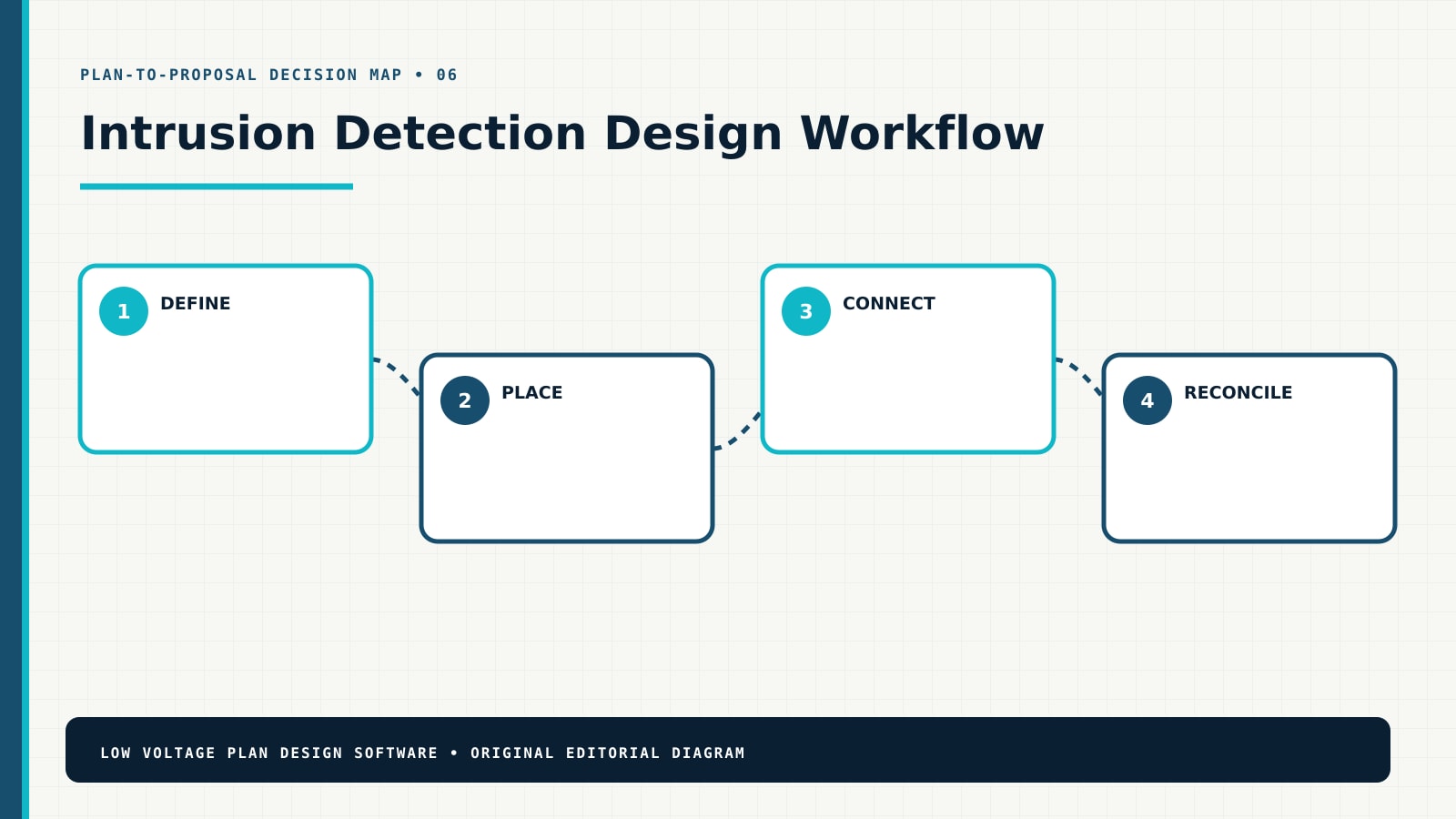
This four-stage sequence keeps design detail proportional to the decision. Early work can show intent and uncertainty. Later work should resolve product-specific interfaces, quantities, installation methods, configuration, testing, and handoff. Do not imply that an early sales layout is permit-ready, engineered, or field-verified unless it actually is.
- Define the operating outcome.Define protected assets, entry paths, operating states, users, response, monitoring, environment, and risk assumptions. At this stage, reject anonymous quantities: each important element needs a location, purpose, relationship, status, or documented basis.
- Place and identify the system.Place detection from a documented purpose and manufacturer basis while distinguishing perimeter, interior, duress, and supervisory functions. At this stage, reject anonymous quantities: each important element needs a location, purpose, relationship, status, or documented basis.
- Connect infrastructure and ownership.Map device and zone IDs to loops, modules, panel capacity, power, communications, pathways, and monitoring responsibility. At this stage, reject anonymous quantities: each important element needs a location, purpose, relationship, status, or documented basis.
- Reconcile scope and handoff.Reconcile programming, verification, user training, permits, monitoring, false-alarm controls, BOM, proposal, and closeout. At this stage, reject anonymous quantities: each important element needs a location, purpose, relationship, status, or documented basis.
Coordination questions to close before the proposal
Door and window types, contacts, frames, hardware, glazing, roll-up doors, roof access, and building envelope
Door and window types, contacts, frames, hardware, glazing, roll-up doors, roof access, and building envelope. Record the value, source, verification status, responsible party, and revision so another person can audit the decision.
Sensor technology, range, mounting, masking, pets, HVAC, sunlight, vibration, stock, partitions, and environmental conditions
Sensor technology, range, mounting, masking, pets, HVAC, sunlight, vibration, stock, partitions, and environmental conditions. Show the relationship on the correct drawing or schedule instead of burying it in a note that cannot be traced.
User schedules, arming process, partitions, cleaning, deliveries, duress, after-hours access, and response expectations
User schedules, arming process, partitions, cleaning, deliveries, duress, after-hours access, and response expectations. Separate observed conditions from design assumptions and customer choices; price uncertainty as an allowance or exclusion when needed.
Monitoring station, communicator, cellular/network service, permits, verification, dispatch policy, and false-alarm requirements
Monitoring station, communicator, cellular/network service, permits, verification, dispatch policy, and false-alarm requirements. Carry stable identifiers into the takeoff, proposal, installation record, test evidence, and closeout documents.
Panel and power location, batteries, circuits, pathways, surge, grounding, network, cybersecurity, and service access
Panel and power location, batteries, circuits, pathways, surge, grounding, network, cybersecurity, and service access. Review capacity, compatibility, access, serviceability, future change, and failure behavior before the product is committed.
Existing-system reuse, device compatibility, takeover limits, warranties, programming ownership, records, and maintenance
Existing-system reuse, device compatibility, takeover limits, warranties, programming ownership, records, and maintenance. Assign ownership at the interface with architecture, electrical, IT, operations, other vendors, and the authority having jurisdiction.
Coordination is part of the product. A device may be inexpensive while its pathway, power, network, mounting, licensing, access, programming, firestopping, outage window, or third-party interface carries the real cost. The drawing set should expose those dependencies early enough for a responsible party to answer them.
Worked example: a neighborhood pharmacy with public sales space, stockroom, office, rear delivery door, and controlled drug storage
Starting problem. The request says “alarm all doors and add motions,” but the operating schedule, delivery process, existing contacts, monitoring path, partitions, and response rules are not documented.
Design response. The plan separates perimeter, interior, high-value, duress, and supervisory purposes, assigns zone IDs, records sensor assumptions, and ties every device to panel, power, communication, and test information.
Commercial and field result. The customer can review how the system will be used, while the contractor prices devices, cable, modules, monitoring prerequisites, programming, training, and exceptions from a traceable basis.
The example is not a product recommendation or a quantity template. Its value is the reasoning chain: define the operating outcome, identify what is verified, document relationships, expose dependencies, and reconcile the resulting work to an issued revision. Reuse that method, but verify every location, dimension, product, code requirement, pathway, calculation, and responsibility on the actual project.
Example review checkpoints
- Can a reviewer explain why every major element exists and which customer outcome it supports?
- Can an estimator trace every major quantity to a plan, schedule, schematic, calculation, allowance, or explicit assumption?
- Can a field technician distinguish approved work, alternates, owner-furnished items, existing conditions, demolition, and unverified conditions?
- Can IT, electrical, architecture, operations, and other vendors see their interfaces without interpreting hidden design intent?
- Can the team record a change once, identify affected documents and quantities, obtain approval, and preserve the prior revision?
- Does the acceptance plan test operating outcomes and interfaces instead of confirming only that devices power on?
How to evaluate intrusion alarm system design software
Use a representative project instead of a polished demonstration. Recreate a real survey condition, one shared infrastructure dependency, one customer change, and one scope alternative. The evaluation should expose whether the tool supports decisions or simply makes drawing faster.
| Test | What good looks like | Warning sign |
|---|---|---|
| Baseline and revisions | Rooms, scale, field evidence, assumptions, issue status, and revisions remain visible and controlled. | A new background or duplicate file silently breaks identities and quantities. |
| Industry documentation | Plans, schedules, schematics, details, notes, and responsibility fields match the discipline. | Generic icons substitute for system relationships and deliverables. |
| Quantity traceability | Equipment, accessories, cable, infrastructure, licenses, labor, and options trace to the approved revision. | The estimate is a separate list that cannot be reconciled to the plan. |
| Customer scope | Inclusions, exclusions, allowances, alternatives, prerequisites, and decisions are understandable. | The proposal promises performance while hiding assumptions and third-party work. |
| Field handoff | Technicians receive stable IDs, current documents, verification items, change control, test expectations, and closeout structure. | Installers work from screenshots or sales notes without revision status. |
| Connected workflow | The plan can support proposal, follow-up, approval, change, and closeout without retyping the project. | Every workspace recreates customer, location, item, quantity, and status data. |
Common failure modes
- Device-count design: a quantity is selected before purpose, geometry, interfaces, or infrastructure are understood.
- Decorative schematic: lines show that boxes connect but omit ports, media, direction, protocol, power, ownership, or failure behavior.
- Invisible shared scope: racks, network, power, pathways, accounts, licensing, programming, and testing are assumed rather than assigned.
- Revision drift: plan, schedule, BOM, proposal, installer copy, and closeout record describe different versions of the project.
- False precision: unmeasured routes, unverified conditions, preliminary models, or early product choices are presented as confirmed facts.
- Weak acceptance: completion means “installed” instead of verified operating outcomes, interfaces, training, documentation, and owner approval.
Focused Intrusion Detection field answers
Use these two query-specific resources when the broad workflow is not enough. Each answer includes a contractor method, worked situation, unique diagram, proposal audit, internal reading path, authoritative references, and a direct connection back to this industry workflow.
Motion Detector Placement Plan: Coverage, Environment and False-Alarm Control
Place intrusion detectors around real movement paths, coverage patterns, mounting instructions, pets, HVAC, sunlight, obstructions, partitions, and walk-test evidence.
Intrusion Alarm Zone List and Wiring Diagram for Serviceable Systems
Create a serviceable record that connects every contact, detector, panic device, tamper, keypad, expander, siren, communicator, circuit, zone type, and response.
Continue the research inside this publication
This canonical page is the industry entry point. Use the related resources below to move from selection into specific drawings, schedules, examples, and workflows. The links use adjacent search language intentionally so readers can follow the problem rather than return to a generic archive.
- intrusion zones and schedule guide — use it to extend this page into the next documented decision.
- sensor coverage and cable guide — use it to extend this page into the next documented decision.
- intrusion discipline hub — use it to extend this page into the next documented decision.
- floor plan versus riser guide — use it to extend this page into the next documented decision.
- proposal design workflow — use it to extend this page into the next documented decision.
Compare this discipline with all 22 low-voltage industry design software workflows, or start from the broader low-voltage disciplines hub. Use the design guides for methods, the plan examples for scenarios, the planning tools for transparent calculations, and the glossary for shared terminology.
Authoritative references to verify for this project
These links are starting points, not substitutes for the adopted code, contract documents, manufacturer instructions, licensed design, or authority approval. Confirm current editions, jurisdiction, product applicability, and project-specific requirements.
- UL Security Alarm Service Certification — intrusion-alarm installation and monitoring standards context.
- UL National Industrial Security Systems — high-security intrusion system context.
- NIST Guide to Intrusion Detection and Prevention Systems — general detection, monitoring, and response concepts.
Frequently asked questions
What should intrusion alarm system design software produce?
It should produce more than a diagram. A useful project record connects locations, identifiers, system relationships, schedules, infrastructure, assumptions, quantities, scope boundaries, review decisions, field changes, testing, and closeout evidence. For this discipline, the minimum useful set normally includes Intrusion device floor plan, Zone and device schedule, Panel/power/communications riser, Partition and response matrix.
Can the software replace engineering, code review, or manufacturer design?
No. Documentation software helps a qualified team organize, communicate, reconcile, and revise the work. It does not grant a license, determine the adopted code, approve a regulated design, validate a proprietary calculation, or replace manufacturer instructions and authority review.
How should a contractor compare intrusion detection design tools?
Test the real workflow. Begin with a survey change, place and identify representative elements, build a schedule or schematic, revise a shared dependency, reconcile quantities, produce customer-readable scope, and inspect the field handoff. A polished symbol library is not enough if identities, relationships, quantities, revisions, and approvals fall apart.
What information belongs on the floor plan?
Keep location-specific information on the plan: room, device or endpoint position, purpose, stable ID, mounting or orientation intent, nearby constraints, and cross-references. Move repeated attributes to schedules and system relationships to a riser, one-line, topology, signal flow, control diagram, or responsibility matrix.
How does this improve the proposal?
The proposal becomes explainable because devices, accessories, cable, infrastructure, licenses, labor, programming, testing, training, allowances, alternatives, and exclusions trace back to an approved design revision. When the drawing changes, the team can find the commercial effect instead of relying on memory.