
A camera BOM and proposal workflow should document surveillance purpose, scene coverage, network resources, recording relationships, and commercial scope without treating every camera symbol as interchangeable. The finished resource must be useful at field scale, traceable to an approved scope, and explicit about anything that has not been verified.
This contractor guide answers the search for security camera bill of materials and proposal with a practical documentation method. It teaches drawing and workflow organization; it does not replace adopted code, engineered design, licensing, manufacturer instructions, contractual requirements, or authority-having-jurisdiction approval.
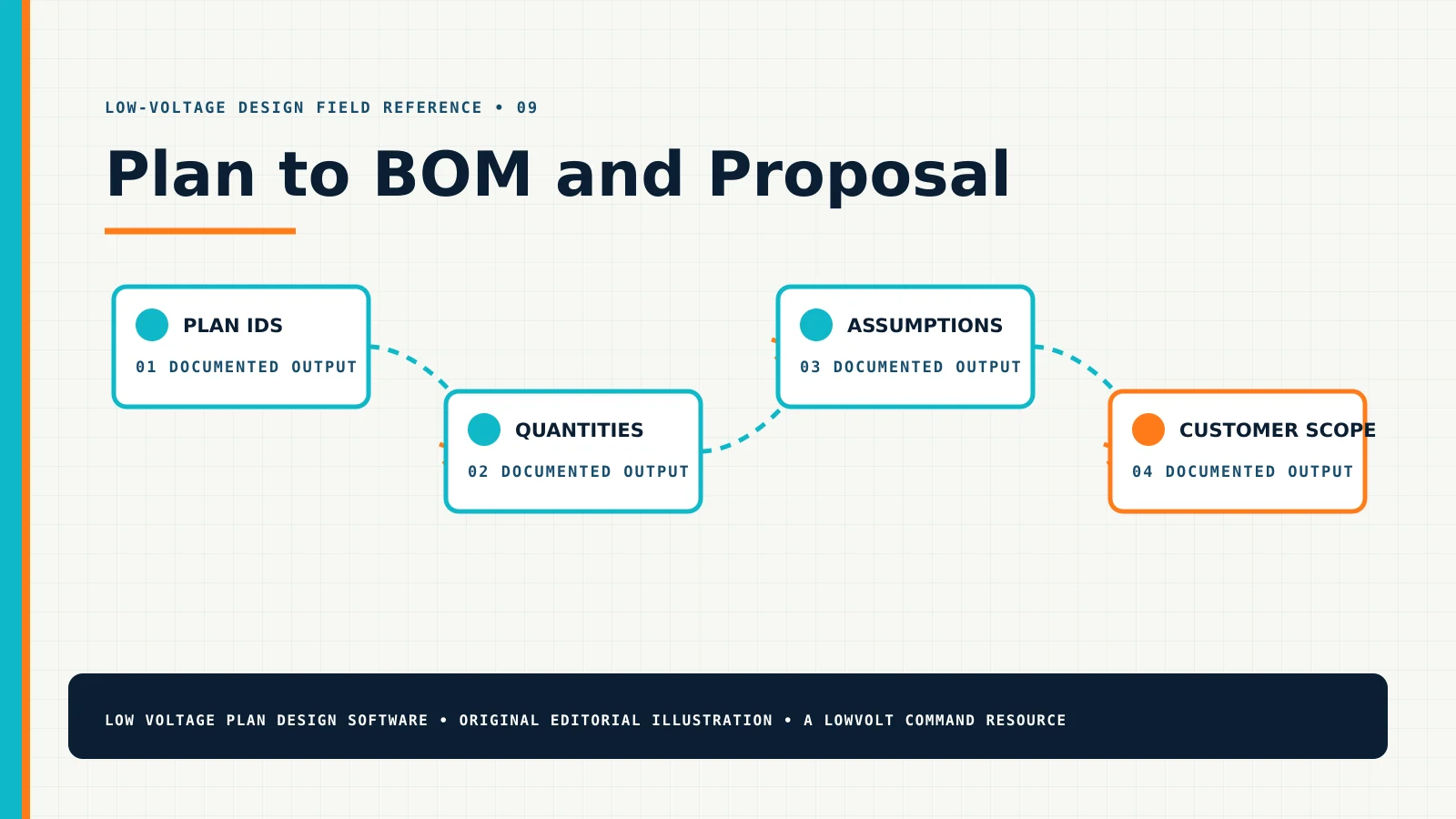
What this document must accomplish
A professional camera BOM and proposal workflow is not a collection of disconnected symbols. It is a controlled project record. The reader should be able to identify the intended function, locate every documented component, follow its relationship to serving equipment, find supporting attributes, understand scope boundaries, and see which conditions still require field confirmation.
Before drawing the camera BOM and proposal workflow, define who will use the document and at what stage: customer review, budgeting, permit or submittal coordination, installation, commissioning, training, service, or record documentation. One drawing may support several stages, but its title, revision, status, and limitations should make the intended use unmistakable.
Information to collect before design
| Priority | Required input | Control |
|---|---|---|
| 1 | scene purpose and threat or operational objective | Record source, status, owner, date, and unresolved assumption. |
| 2 | mounting position, height, light, obstruction, and environmental conditions | Record source, status, owner, date, and unresolved assumption. |
| 3 | lens, resolution, pixel-density, motion, and retention assumptions | Record source, status, owner, date, and unresolved assumption. |
| 4 | PoE, switching, uplink, recorder, storage, UPS, and cybersecurity boundaries | Record source, status, owner, date, and unresolved assumption. |
While developing the camera BOM and proposal workflow, do not hide missing information inside a generic allowance. Mark inaccessible areas, unavailable backgrounds, undecided equipment, unconfirmed pathways, and owner decisions as open items. Assign each item an owner and next action so it can be resolved before it becomes a field change.
Demonstrate why counting camera symbols is not enough to price a complete surveillance project.
Required workflow
- Freeze the reviewed plan revision and export camera/device counts.
- Resolve dependencies for each device: mount, housing, junction, power/PoE, cable, pathway, licenses, storage, accessories, and installation condition.
- Add recorder/network infrastructure, displays, UPS, configuration, testing, training, documentation, and allowances.
- Separate base scope, options, customer-provided items, exclusions, and uncertain conditions.
- Reconcile BOM quantities to proposal line items before issue.
Documented example to create
Use one redacted project to show the plan count, dependency matrix, BOM, and customer scope side by side. Include an error example caught by reconciliation.
Technical review
Exclude invented pricing and verify every product workflow claim before the Proposal Center CTA.
Documentation fields that make the guide buildable
For the camera BOM and proposal workflow, use stable device and segment identifiers. Pair every symbol with enough schedule data to distinguish it from similar-looking devices. Typical controlled fields include location, device type, mounting, serving room/rack/panel, pathway or cable ID, existing/new status, model basis, quantity relationship, responsibility, and installation or testing notes. Add discipline-specific fields only when they improve a real decision.
To keep the camera BOM and proposal workflow readable, place repeated detail in schedules rather than covering the plan with notes. The drawing communicates spatial relationships; a riser communicates topology; a rack elevation communicates physical equipment order; a signal-flow diagram communicates logical connectivity; and a schedule carries repeated attributes. Cross-reference these documents instead of forcing all information onto one sheet.
Coordination and related low-voltage references
Within the camera BOM and proposal workflow, cross-check optical intent against the network and recording design. A camera that looks correct on a plan can still fail its purpose because of scene width, backlight, motion, compression, mounting limits, bandwidth, storage, or an unverified accessory. Keep camera IDs consistent across plan, schedule, switch port, recorder, test result, and proposal.
- How to Plan Security Camera Placement on a Floor Plan — use this related reference to keep shared IDs, pathways, and project assumptions consistent.
- How to Document an NVR and PoE Security Camera Network — use this related reference to keep shared IDs, pathways, and project assumptions consistent.
- Low-Voltage Floor Plan Design Workflow — use this related reference to keep shared IDs, pathways, and project assumptions consistent.
Estimating, proposal, and field-handoff implications
Translate the documented devices and pathways in the camera BOM and proposal workflow into quantities while preserving the basis. Device counts alone rarely equal a complete bill of materials. Review mounting accessories, interfaces, licenses, power, batteries, switching, patching, rack hardware, cable, pathway materials, connectors, labels, testing, lifts, mobilization, training, closeout, and project-specific services. Keep measured quantities separate from allowances and uncertainty.
The customer-facing scope associated with the camera BOM and proposal workflow should point to the approved drawing revision and explain inclusions, exclusions, options, owner responsibilities, assumptions, and acceptance criteria in plain language. When the plan changes, review the BOM, labor, proposal, schedule, and follow-up record together.
Worked documentation example
Use a small controlled example before scaling the camera BOM and proposal workflow across the full project. Choose one representative room, opening, pathway, rack, zone, or system branch and follow every identity through the drawing set. This exposes naming conflicts and missing schedule fields while they are still inexpensive to correct.
| Sequence | Example element | Required relationship | Review state |
|---|---|---|---|
| 1 | plan ids | Assign a stable ID, document the design basis, and reference the supporting plan, schedule, riser, or test record. | Open until its source and responsible reviewer are recorded. |
| 2 | quantities | Assign a stable ID, document the design basis, and reference the supporting plan, schedule, riser, or test record. | Open until its source and responsible reviewer are recorded. |
| 3 | assumptions | Assign a stable ID, document the design basis, and reference the supporting plan, schedule, riser, or test record. | Open until its source and responsible reviewer are recorded. |
| 4 | customer scope | Assign a stable ID, document the design basis, and reference the supporting plan, schedule, riser, or test record. | Open until its source and responsible reviewer are recorded. |
After the camera BOM and proposal workflow example is reviewed, apply the same information model to similar items without assuming that their field conditions are identical. Copy the structure, not unverified values. Record deviations such as a different mounting surface, longer route, alternate lock function, higher PoE load, changed signal format, or inaccessible ceiling as explicit project data.
Revision control from survey through closeout
Give every issued camera BOM and proposal workflow version a date, revision identifier, purpose, and accountable owner. Preserve the previous approved version so the team can explain what changed. A useful revision note identifies affected devices or segments and the downstream documents that require review. “Updated plan” is not enough when the change also affects ports, licensing, storage, rack units, cable quantities, labor, scope, or customer price.
During installation of the work documented by the camera BOM and proposal workflow, collect marked-up changes against the same identifiers used in design. Resolve discrepancies before producing record documents. Closeout should connect the installed item to its label, test or commissioning result, configuration record where appropriate, customer training or acceptance evidence, and final drawing reference. That traceability is what turns a design graphic into an operational project record.
Failure-mode review for the camera BOM and proposal workflow
A quality review should test how the documentation could mislead the next person, not merely confirm that required graphics are present. For the camera BOM and proposal workflow, select the relationships that carry the most technical or commercial risk and follow each from the observed condition through design, estimate, proposal, installation, testing, and closeout. This reveals gaps that a symbol count will not expose.
| Review element | Failure to prevent | Documentation control | Evidence |
|---|---|---|---|
| plan ids | If plan ids is missing or ambiguous, a camera can be installed and connected yet still fail its scene, recording, retention, or cybersecurity purpose. | Cross-reference plan ids to item 1 in the related schedule, diagram, decision log, and acceptance record. | Record reviewer, date, evidence, and approved revision. |
| quantities | If quantities is missing or ambiguous, a camera can be installed and connected yet still fail its scene, recording, retention, or cybersecurity purpose. | Cross-reference quantities to item 2 in the related schedule, diagram, decision log, and acceptance record. | Record reviewer, date, evidence, and approved revision. |
| assumptions | If assumptions is missing or ambiguous, a camera can be installed and connected yet still fail its scene, recording, retention, or cybersecurity purpose. | Cross-reference assumptions to item 3 in the related schedule, diagram, decision log, and acceptance record. | Record reviewer, date, evidence, and approved revision. |
| customer scope | If customer scope is missing or ambiguous, a camera can be installed and connected yet still fail its scene, recording, retention, or cybersecurity purpose. | Cross-reference customer scope to item 4 in the related schedule, diagram, decision log, and acceptance record. | Record reviewer, date, evidence, and approved revision. |
Resolve failures according to consequence. Stop and obtain qualified direction when life safety, egress, structural support, electrical power, environmental rating, cybersecurity ownership, code, licensing, or manufacturer limitations are involved. For commercial uncertainty, keep the assumption visible and connect it to an allowance, alternate, exclusion, responsible party, and due date. Recheck the camera BOM and proposal workflow after every decision that changes quantities, labor, equipment, software, pathway, testing, training, or customer scope.
Common mistakes to prevent
- Using a symbol or line without a stable identifier or schedule relationship.
- Copying a previous-project layout without verifying current purpose and conditions.
- Presenting an assumption as a verified fact.
- Allowing the plan, riser, schedule, BOM, and proposal to use different names for the same item.
- Adding detail until the drawing is unreadable instead of using cross-referenced documents.
- Ignoring service access, testing, labeling, closeout, and future revision needs.
From Security Camera Plan to Bill of Materials and Proposal quality-control checklist
- Confirm that plan ids is visible, traceable, and coordinated with the related schedule or diagram.
- Confirm that quantities is visible, traceable, and coordinated with the related schedule or diagram.
- Confirm that assumptions is visible, traceable, and coordinated with the related schedule or diagram.
- Confirm that customer scope is visible, traceable, and coordinated with the related schedule or diagram.
- Confirm that the title, revision, status, scale or diagrammatic note, and intended use are visible.
- Confirm that existing, new, relocated, removed, alternate, and future work cannot be confused.
- Confirm that quantities and proposal language trace back to the approved design revision.
- Review all safety, compliance, manufacturer, and jurisdiction-specific statements with the qualified responsible party.
Related questions
How detailed should the security camera bill of materials and proposal be?
The camera BOM and proposal workflow should be detailed enough that the intended reader can make the next approved decision without guessing, but separated into plans, schedules, risers, and supporting documents when density harms readability.
Can this drawing generate a bill of materials automatically?
The camera BOM and proposal workflow can control device and pathway quantities, but the estimator still must review accessories, labor, services, allowances, commercial scope, and conditions that a plan cannot prove.
What should happen when field conditions differ?
When field conditions conflict with the camera BOM and proposal workflow, record the condition and stop work when safety or authorization requires it, obtain the appropriate decision, revise affected documents, and preserve the approved change through closeout.
Field verification and decision record
Review the security camera bill of materials and proposal in the field with the drawing available at a usable scale. Walk the intended sequence rather than checking symbols randomly. Confirm the scene purpose, mounting, optical performance, network, recording, power, storage, cybersecurity, and test result. Photograph or note the condition that supports each important decision. Where a customer, IT representative, door-hardware consultant, electrician, architect, engineer, manufacturer, or authority must decide, record the responsible party and deadline instead of substituting an installer assumption.
For decisions affecting the camera BOM and proposal workflow, use a decision log for issues that can change cost or performance. Each entry should include the related device or segment ID, observed condition, available options, technical and commercial effect, requested decision, decision owner, date, and the revision where the result was incorporated. This gives sales and operations the same history and prevents an email approval from becoming disconnected from the plan.
Questions for the final design review
- Can a field technician locate every planned item and distinguish it from nearby work?
- Can the estimator trace every major quantity and allowance to a documented basis?
- Can the project manager identify prerequisites and work assigned to another trade?
- Can the customer understand the intended outcome and important exclusions without reading internal shorthand?
- Can a reviewer follow the relationship among plan, schedules, risers, equipment layouts, proposal, and revision record?
- Can the service team identify what was actually installed after closeout?
If any answer is no, improve the camera BOM and proposal workflow documentation before adding more decorative detail. The goal is not the busiest drawing; it is the clearest controlled record that supports the next action.
Authoritative external references
Use external references to verify terminology and current technical context, not to imply that a general article satisfies a project-specific standard.
- Consult ONVIF Profiles for IP physical-security interoperability; verify the current edition or product version that applies to the project.
- Consult ONVIF Cybersecurity Recommendations for segmentation and secure network-video design; verify the current edition or product version that applies to the project.
- Consult Axis Network Video Fundamentals for field of view, pixel density, bitrate, PoE, and system-design concepts; verify the current edition or product version that applies to the project.
Using security camera bill of materials and proposal after approval
Issue the approved camera BOM and proposal workflow document in a format the field team can open, print, and identify. Preserve the native project data as well as the customer-facing export. Link the final drawing to its schedules, estimate, accepted proposal, and project record. At closeout, compare the approved intent with verified installation, record authorized deviations, and schedule future review where product configuration, network ownership, space use, or customer requirements may change.